What is History?
History is the study of the human past through the traces it left behind — chiefly written records, but also objects, landscapes, bodies, and inherited memory — and the disciplined interpretation of those traces into accounts of what happened and why.
The word and the boundary it draws
The English history descends from the Greek ἱστορία (historíā), "inquiry," the term Herodotus used to open his Histories (c. 430 BCE): "the setting forth of the historíē of Herodotus of Halicarnassus, so that human deeds may not be effaced by time." Embedded in the word is an epistemic claim: history is not chronicle but investigation, a reasoned reconstruction from evidence. Yet the discipline has long been shadowed by a definitional fault line — the boundary between "history" and "prehistory," conventionally set at the invention of writing.
That boundary is arbitrary in a revealing way. Cuneiform emerges in Sumer around 3200 BCE, first as accounting notation on clay in Uruk, then as a full script capable of recording narrative, law, and myth. Egyptian hieroglyphs follow within a century or two. On the strict textual definition, "history" is roughly 5,000–6,000 years old. But anatomically modern Homo sapiens is at least 300,000 years old (the Jebel Irhoud fossils in Morocco, redated in 2017), and the genus Homo far older. The overwhelming majority of the human career therefore falls outside "history" as conventionally defined — a scandal that modern scholarship has spent a century trying to resolve.
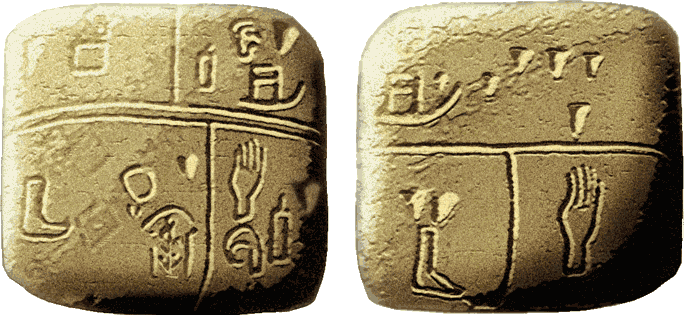
An early cuneiform pictographic tablet from Kish (c. 3500 BCE), among the oldest known writing — source
What historians study, and how they know it
The historian's raw material is the primary source — a trace produced by or close to the events under study: a treaty, a tax roll, a diary, a potsherd, a skeleton, a pollen core. From these the historian constructs interpretations, always mediated by the source's own perspective, purpose, and silences. The craft rests on a set of techniques often traced to the antiquarian and philological traditions: diplomatics (the authentication of documents, systematized by Jean Mabillon in De re diplomatica, 1681), source criticism distinguishing Quellenkritik (external authenticity) from Tendenzkritik (internal bias), and the reconstruction of context.
Two Greek founders frame the enduring tension. Herodotus gathered oral testimony, ethnography, and marvel, reporting variant accounts and often withholding judgment ("my business is to record what people say, but I am by no means bound to believe it"). Thucydides, writing on the Peloponnesian War (c. 400 BCE), narrowed the aperture to contemporary political and military events he could cross-examine, disdaining the "romantic" and claiming a "possession for all time" (κτῆμα ἐς αἰεί). The split between Herodotean capaciousness and Thucydidean rigor recurs throughout the discipline's history.
Ranke, the archive, and the professional turn
The modern research paradigm crystallized in nineteenth-century Germany. Leopold von Ranke, in the preface to his Geschichten der romanischen und germanischen Völker (1824), issued the famous disclaimer that history should show "wie es eigentlich gewesen" — usually rendered "how it actually was," though eigentlich better reads as "essentially" or "characteristically," a subtler claim than naïve positivism allows. Ranke's real innovation was institutional: the seminar, the primacy of unpublished archival documents (he mined the Venetian relazioni), and the footnote as an apparatus of verifiability. History became a research profession with credentialing, journals (the Historische Zeitschrift, 1859), and a canon of method.
Ranke's model was powerful but partial. Its privileging of state archives biased history toward diplomacy, war, and elites — the domains that generate and preserve documents. This documentary bias is structurally connected to the history/prehistory divide: both encode the assumption that only the textually recorded past is fully knowable.
The tens of thousands of missing years
Archaeology, paleoanthropology, genetics, and climate science have made the pre-literate past densely legible, undermining the claim that writing marks the onset of real knowability.
- The Paleolithic longue durée. For hundreds of millennia, human life is reconstructed from lithic technology (Oldowan, Acheulean, Mousterian, Aurignacian toolkits), hearths, faunal remains, and dwelling sites. This immense, slow-moving time frame resonates with Fernand Braudel's tripartite temporality — the near-motionless longue durée of geography and climate beneath the medium rhythms of social structure and the fast surface of events (histoire événementielle), set out in La Méditerranée (1949).
- Behavioral modernity and cave art. Symbolic behavior — the engraved ochre of Blombos Cave (c. 75,000 BCE), the painted animals of Chauvet (c. 36,000 BCE) and Lascaux (c. 17,000 BCE), the recently dated figurative art of Sulawesi (at least 45,500 BCE) — testifies to cognition, cosmology, and social meaning with no accompanying text. Whether these mark a sudden "cognitive revolution" or a gradual accumulation remains debated.
- Migrations out of Africa. Population genetics — mitochondrial and Y-chromosome coalescence, and ancient DNA since Svante Pääbo's Neanderthal and Denisovan genomes (2010) — has rewritten the peopling of the planet, documenting admixture events (all non-Africans carry Neanderthal ancestry) invisible to any archive.
- The Neolithic revolution. V. Gordon Childe's term (1930s) for the independent domestication of plants and animals in the Fertile Crescent (c. 9500 BCE), the Yangtze and Yellow River basins, Mesoamerica, and the Andes — reconstructed from carbonized seeds, isotopic diet signatures, settlement plans like Çatalhöyük, and climate proxies (ice cores, speleothems) tracking the Younger Dryas and the Holocene warming that made farming possible.
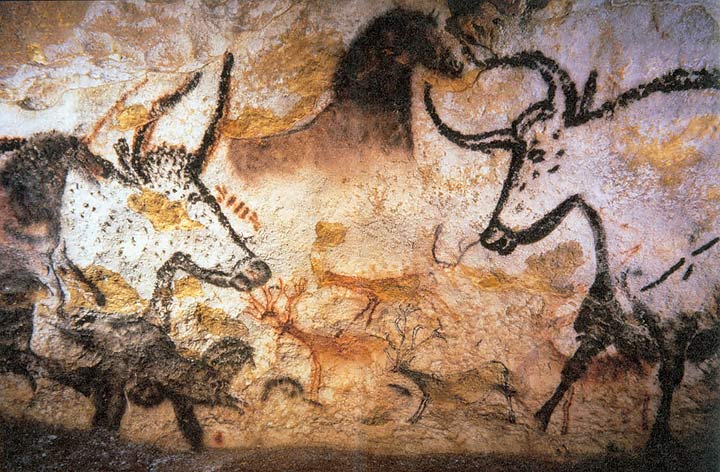
The "Hall of the Bulls" at Lascaux (c. 17,000 BCE) — a wordless yet richly legible record of Paleolithic life — source
These knowledge systems are epistemically different from text — probabilistic, inferential, model-dependent — but not inferior. If anything, radiocarbon dating (Willard Libby, 1949), dendrochronology, Bayesian chronological modeling, and aDNA have given prehistory a precision many textual chronologies lack.
Deep history and big history
Two movements press the argument that the writing threshold should be abandoned as a disciplinary boundary. Deep history, articulated by Daniel Lord Smail in On Deep History and the Brain (2008), argues that historians should treat the Paleolithic as continuous with the documented past, integrating neurobiology, evolutionary theory, and archaeology rather than ceding "prehistory" to other fields. Big history, associated with David Christian (Maps of Time, 2004) and institutionalized in courses funded partly by the Gates Foundation, embeds human history in a cosmological narrative from the Big Bang through stellar nucleosynthesis, planet formation, and biological evolution, organized around rising "complexity" and energy flows.
Both face principled objections. Critics ask whether stretching "history" across scales at which human agency and intention vanish dissolves the very object — purposeful human action interpreted through meaning — that distinguishes history from natural science. This recapitulates the old Methodenstreit between Wilhelm Dilthey's Geisteswissenschaften (sciences of the spirit, aiming at Verstehen, understanding) and the nomothetic natural sciences (aiming at Erklären, causal explanation), a distinction sharpened by the Baden neo-Kantians Windelband and Rickert.
Can history be objective?
The most sustained modern meditation on the discipline's self-understanding is E. H. Carr's What Is History? (1961), delivered as the Trevelyan Lectures at Cambridge. Against Rankean naïveté, Carr insisted that "the facts of history never come to us 'pure,' since they do not and cannot exist in a pure form: they are always refracted through the mind of the recorder." His definition — history as "a continuous process of interaction between the historian and his facts, an unending dialogue between the present and the past" — foregrounds selection: of the countless things that happened, only those a historian deems significant become "historical facts."
Carr's relativism was itself contested. Geoffrey Elton's The Practice of History (1967) defended the autonomy of evidence against present-minded distortion. The debate deepened with the linguistic turn: Hayden White's Metahistory (1973) argued that historical narratives are structured by literary tropes (metaphor, metonymy, synecdoche, irony) and emplotted as romance, tragedy, comedy, or satire — that the past acquires meaning only through narrative forms not given by the evidence. Postmodern challenges (Keith Jenkins, and more radically the "impossibility of representation" pressed after the Holocaust) forced the question of whether any reference to a real past survives.
Most working historians settled on a chastened realism, well expressed by Marc Bloch — co-founder of the Annales and a martyr of the French Resistance, shot by the Gestapo in 1944 — in the unfinished Apologie pour l'histoire (The Historian's Craft, posthumous 1949). Bloch treated evidence as témoins malgré eux, "witnesses in spite of themselves," most revealing precisely where they did not intend to inform. Objectivity, on this view, is not a God's-eye neutrality but a disciplined, self-critical, intersubjective method: falsifiable claims, transparent sourcing, and openness to the "witnesses" who never meant to testify — whether a Sumerian ration tablet or a strand of ancient DNA.
Open questions
- Should the history/prehistory divide be retired entirely, and if so, what unifies "history" across a 300,000-year span?
- Can the Verstehen tradition — history as interpretation of meaning — be reconciled with the model-driven, non-intentional explanations of big history and paleoclimatology?
- How do oral traditions (e.g., Australian Aboriginal accounts of sea-level rise plausibly transmitted over millennia) rank epistemically against text and material evidence?
- After the linguistic turn and the "material turn," what is the status of historical truth — correspondence, coherence, or warranted assertibility?
Further exploration
- Herodotus, The Histories (c. 430 BCE) — the founding act of inquiry; read for its method of reporting conflicting testimony rather than its conclusions.
- Thucydides, History of the Peloponnesian War (c. 400 BCE) — the rigorous, contemporary, source-critical alternative to Herodotus.
- Marc Bloch, The Historian's Craft (1949) — a luminous, unfinished defense of history's method, written under Nazi occupation.
- E. H. Carr, What Is History? (1961) — the indispensable modern reflection on facts, selection, and the historian's standpoint.
- Geoffrey Elton, The Practice of History (1967) — the empiricist rejoinder to Carr; read them as a pair.
- Fernand Braudel, The Mediterranean and the Mediterranean World in the Age of Philip II (1949) — the longue durée in monumental practice.
- Hayden White, Metahistory (1973) — the provocation that historical writing is irreducibly literary.
- Daniel Lord Smail, On Deep History and the Brain (2008) — the case for dissolving the prehistory boundary.
- David Christian, Maps of Time: An Introduction to Big History (2004) — the cosmological reframing of the human story.
- The Chauvet and Lascaux cave paintings — visit the reconstructions or Werner Herzog's Cave of Forgotten Dreams (2010) to confront a past that speaks without writing.